The King Is Dead: A Transition of the Pride and Power
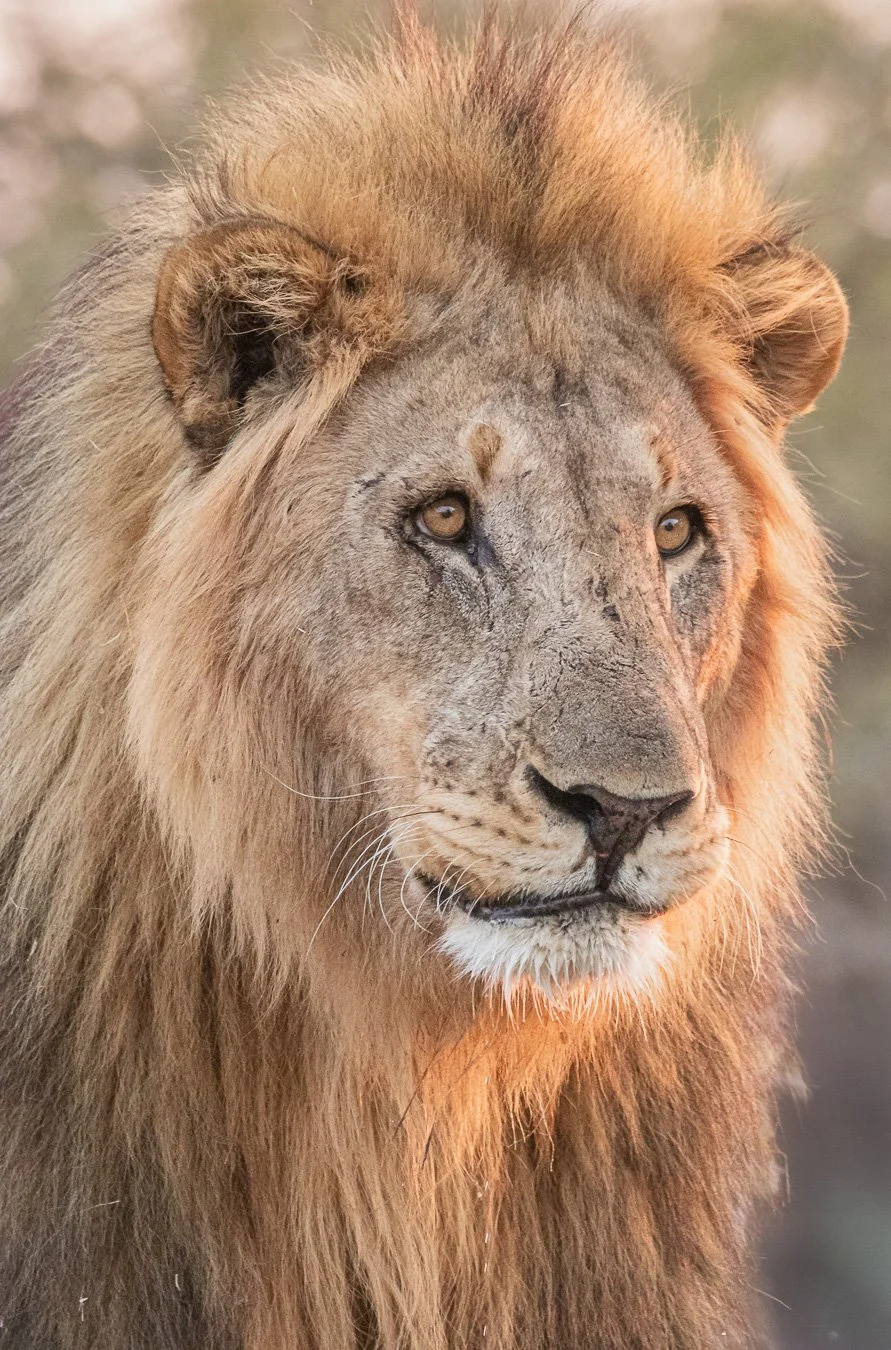
Brownie in all his glory.
Life seemed good for the Onguma pride. Blondie and Brownie were the dominant males of a pride that numbered 16 lions, and together, the brothers held a firm grip on their territory. They were successful hunters, capable of taking down anything from impalas to giraffes. They had even pushed another coalition of males farther north, expanding the territory they controlled. Only four months ago, new cubs entered the pride. The territory appeared secure, the pride was growing and the two brothers were strong.But peace does not last long in the bush.
Two younger males from the east had started moving closer and closer to the boundary of Blondie and Brownie’s territory. Small battles were being fought along the edges. These confrontations were often short-lived, and the younger males would retreat to lick their wounds. Still, they kept returning. Each confrontation was a test of the resident coalition’s strength and another opportunity to look for weakness. Blondie and Brownie continued to defend what was theirs, but the pressure along the eastern boundary was building.
Then, last week, everything changed. A nighttime battle became something much greater, and Brownie sustained deep wounds to his groin. In the days that followed, he remained alone and was barely able to walk. Without the strength to hunt, his condition continued to decline. His injuries may have become infected, while hunger and dehydration may have weakened him further. Hyenas moving through the darkness may also have presented another threat to a lion no longer strong enough to defend himself.
A graphic visual of Brownies injures showing how brutal and intense these battles end up. Surviving the fight doesn’t always mean survival itself.
The exact final cause of his death may never be known, but a few days after the fight, Brownie succumbed to his injuries. His death marked the end of a powerful partnership and left his brother, Blondie, to hold the territory and protect the pride alone.
Male lions form coalitions because there is strength in numbers. These coalitions are often made up of brothers who leave their original pride and face life together. They patrol, hunt, roar, and fight beside one another. Blondie has not only lost his brother. He has lost the lion who helped him build and protect everything they controlled. Together, they could patrol different sections of their territory, answer one another’s calls, and confront rivals as a pair. Each brother provided another set of eyes, another powerful voice in the night, and another body ready to fight.
Now, all of that responsibility rests with Blondie. The younger males have already shown that they are willing to challenge him, and they know that the coalition they were once unable to defeat has been reduced to a single lion. The battle may be over, but the attempted takeover may not be.
Over the next few weeks, Blondie will have to show that the territory is still occupied. He may patrol more frequently, scent-mark, and roar to announce his presence. He may remain close to the pride, knowing that the younger males could return at any time. Doing all of this alone, however, will require an enormous amount of energy. Blondie must protect a territory that was once defended by two males. If the younger coalition returns, he will face them without the brother who once stood beside him.
His choices are limited. He may remain and fight to protect the pride, or he may move away from the area to avoid another confrontation. If the younger males overpower him, he could be injured, killed, or forced into a nomadic life.
For the lionesses, Brownie’s death does not mean that the pride will immediately fall apart. The females are the foundation of a lion pride. They are usually related to one another and often remain within the same home range throughout their lives. Resident males may change, but the lionesses and their territory can remain.
For the four-month-old cubs, however, the danger is very real. If Blondie retains control, he may continue protecting them. If the younger males successfully take over the pride, the cubs could be killed. Incoming males sometimes kill dependent cubs fathered by the previous coalition. This allows the females to return to reproductive condition sooner, giving the new males an opportunity to father their own offspring.
It is a brutal part of lion life, but it is also one of the reasons territorial battles carry such enormous consequences. The outcome affects far more than the males involved in the fight. The lionesses may attempt to hide or defend their cubs, move them away from the approaching males or temporarily separate themselves from the pride. At only four months old, however, the cubs still depend completely on their mothers and remain extremely vulnerable.
The territory is also entering a period of uncertainty. Brownie’s death does not automatically give control to the younger males. They must still displace Blondie, remain in the area, and establish themselves as the new resident coalition. Their behavior over the coming weeks will begin to tell the story. If they retreat east and Blondie continues patrolling, roaring, and remaining with the pride, he may still be in control. If the younger males remain inside the territory, begin scent marking, roar regularly, and move closer to the lionesses, the takeover is likely continuing.
The boundaries that Blondie and Brownie once defended together may also begin to shift. Another coalition could move into the northern section of the territory that the brothers had previously expanded into. An area that once appeared secure may now be tested from more than one direction.
The next few weeks could be some of the most consequential the Onguma pride will ever experience. Blondie may prove strong enough to hold the territory alone, or the younger males may decide that another fight is not worth the risk. They may also return and complete what they started. Nothing is certain.
That is the reality of life in the bush. Strength is temporary, territory must constantly be defended, and even the most powerful lions eventually face a younger generation waiting for its opportunity. For years, Blondie and Brownie ruled together. They hunted, expanded their territory, and helped bring a new generation of cubs into the pride. Now, one brother is gone, and Blondie remains standing between the younger males and everything the brothers once protected together.
The king is dead. What happens next will determine who inherits his kingdom.
The Lion pride is spending some quality time together. One of the first few times we were able to see the pride all together.
Sources
Felix, N., Kissui, B. M., Munishi, L., and Treydte, A. C. (2022). Retaliatory killing negatively affects African lion male coalitions in the Tarangire Manyara Ecosystem, Tanzania. PLOS ONE, 17(8).Packer, C., and Pusey, A. E. (1983). Adaptations of female lions to infanticide by incoming males. The American Naturalist, 121(5), 716 to 728.Bygott, J. D., Bertram, B. C. R., and Hanby, J. P. (1979). Male lions in large coalitions gain reproductive advantages. Nature, 282, 839 to 841.Grinnell, J., Packer, C., and Pusey, A. E. (1995). Cooperation in male lions: kinship, reciprocity or mutualism?. Animal Behaviour, 49(1), 95 to 105.